JAN 2026
How Nose-to-Brain Delivery Is Revolutionizing CNS Therapeutics
SYNOPSIS
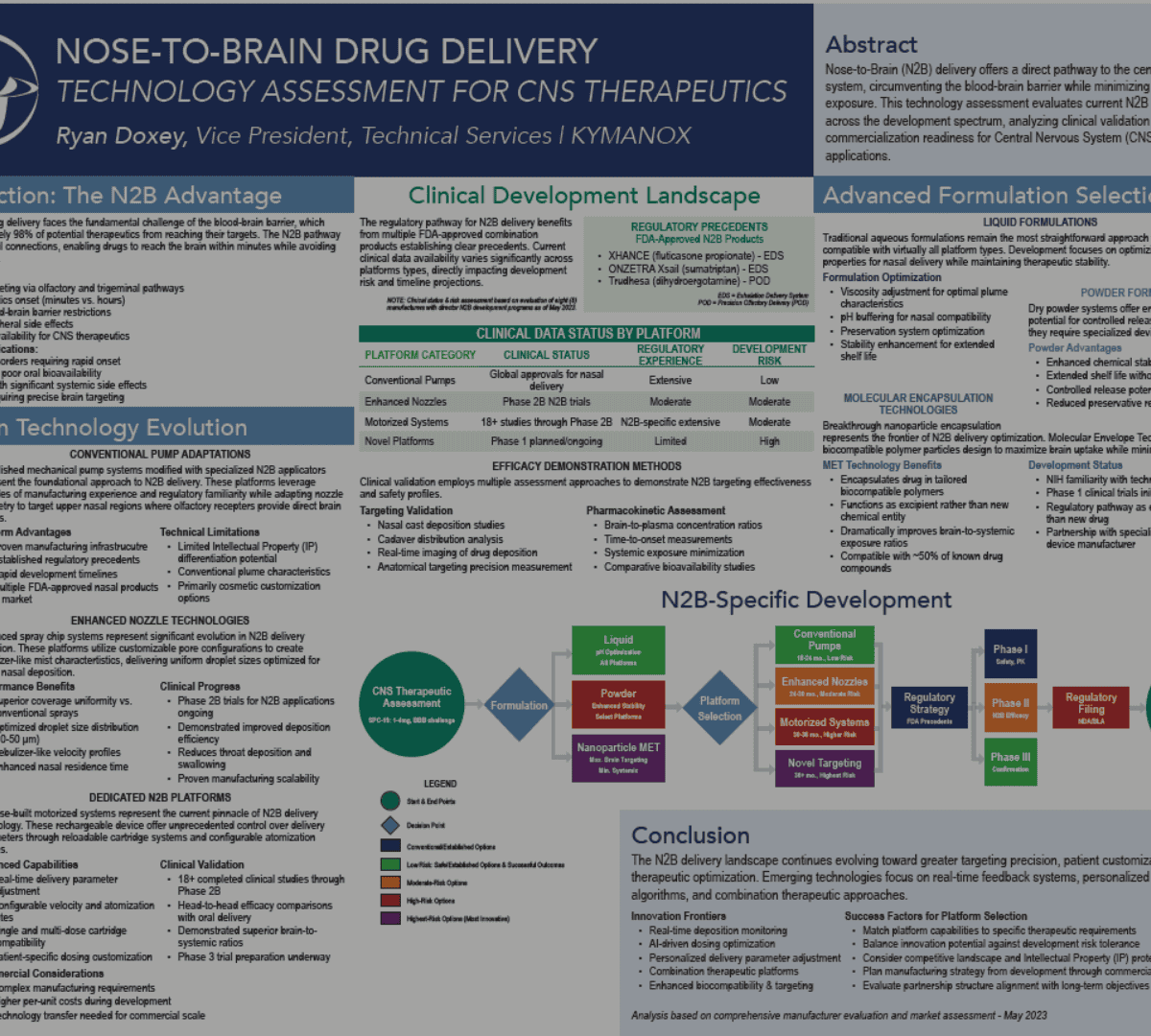
Breaking through the blood–brain barrier has challenged drug developers for decades, blocking nearly 98% of potential CNS therapeutics. Nose-to-brain delivery is changing that reality. By using specialized nasal delivery platforms to bypass systemic circulation and directly target the central nervous system, drugs can reach the brain within minutes — with improved bioavailability and reduced peripheral side effects. This article explores nose-to-brain delivery technologies, regulatory precedent, formulation strategies, and how developers can select the right platform to accelerate CNS innovation.
The Challenge That’s Stumped Drug Developers for Decades
Imagine developing a promising drug that could treat Alzheimer’s Disease, Parkinson’s Disease, or severe migraines, only to discover it cannot reach its target. This is the reality for approximately 98% of potential therapeutics for brain disease or disorder applications, they are blocked by one of nature’s most formidable obstacles: the blood-brain barrier (BBB).
But what if there was a way around this barrier? This secondary route exists and is referred to as nose-to-brain delivery.
A Direct Route to the Central Nervous System (CNS)
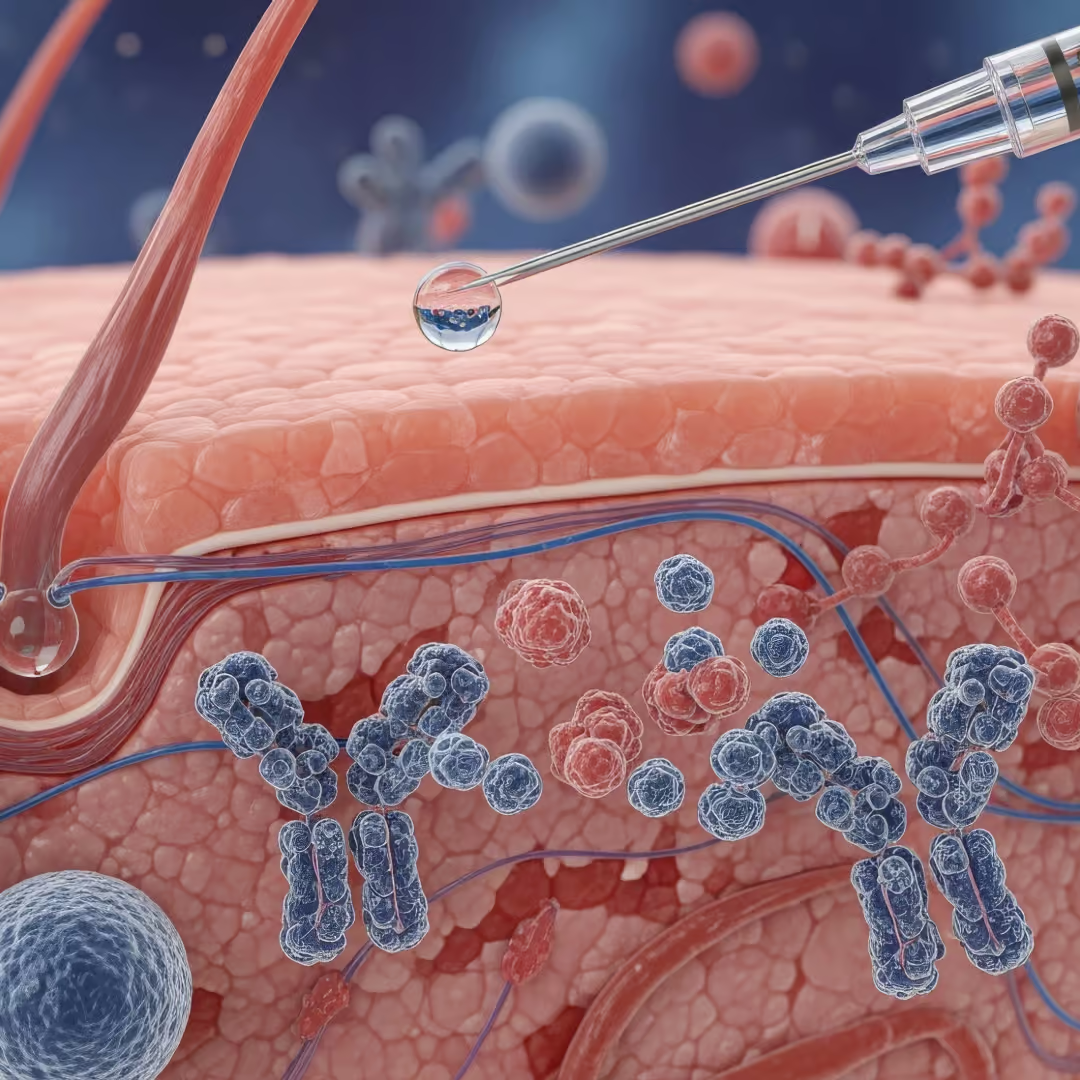
Nose-to-brain (N2B) delivery technology exploits a fascinating aspect of human anatomy: the direct neural connections between the nasal cavity and the brain. By delivering drugs through the nose via devices with specially designed nozzles, therapeutics can reach the central nervous system in minutes, completely bypassing the BBB and avoiding systemic circulation thereby minimizing the peripheral side effects.
Why N2B Delivery Is a Game-Changer
- Speed: Rapid therapeutic onset allowing drugs to reach the brain in minutes rather than hours
- Precision: Direct CNS targeting through olfactory and trigeminal pathways
- Safety: Minimized peripheral side effects by avoiding systemic circulation
- Efficiency: Enhanced bioavailability for CNS therapeutics that typically struggle with oral delivery
- Accessibility: Breakthrough potential for neurological disorders requiring rapid onset therapeutics

The Technology Landscape: From Pumps to Smart Systems
The N2B delivery field has evolved dramatically, with platforms ranging from adapted conventional pumps to sophisticated motorized systems.
Conventional Pump Adaptations: The Reliable Foundation
Think of these as the trusty pickup trucks of N2B delivery: proven, reliable, and ready to go. These systems modify established mechanical pump technology with specialized nozzles designed to target the upper nasal regions where olfactory receptors provide direct brain access.
- The upside: Decades of manufacturing experience, extensive regulatory precedents, and rapid development timelines (18-24 months). Multiple FDA-approved nasal products already validate this approach.
- The limitation: Limited intellectual property differentiation and primarily cosmetic customization options.
- Development risk: Low
Enhanced Nozzle Technologies: Precision Engineering
These advanced spray chip systems represent a significant leap forward in delivery precision. By utilizing customizable pore configurations, they create nebulizer-like mist characteristics with optimized droplet sizes (10-50 μm) for superior upper nasal deposition.
- Advantage: Superior coverage uniformity, enhanced nasal residence time, and reduced throat deposition that minimizes swallowing, which isa common problem with conventional sprays.
- Clinical progress: Phase 2B trials for N2B applications are currently ongoing, with demonstrated improvements in deposition efficiency and proven manufacturing scalability.
- Development risk: Moderate (24-30 month timelines)
Dedicated Motorized N2B Platforms: The Smart Solution
These purpose-built, rechargeable devices represent the current pinnacle of N2B delivery technology. With reloadable cartridge systems and configurable atomization profiles, they offer unprecedented control over delivery parameters.
- Advanced capabilities: Real-time delivery parameter adjustment, configurable velocity and atomization rates, single and multi-dose compatibility, and patient-specific dosing customization.
- Clinical validation: Impressive track record with 18+ completed studies through Phase 2B, including head-to-head efficacy comparisons with oral delivery. Results show superior brain-to-systemic ratios, with Phase 3 trials now in preparation.
- Trade-off: Higher complexity means increased per-unit costs during development and technology transfer requirements for commercial scale manufacturing.
- Development risk: Moderate (30-36 months)
FDA Approval: The Path Is Already Paved
One of N2B delivery’s greatest advantages is that multiple FDA-approved combination products have already established clear regulatory precedents. For example:
- XHANCE (fluticasone propionate) – Exhalation Delivery System
- ONZETRA Xsail (sumatriptan) – Exhalation Delivery System
- Trudhesa (dihydroergotamine) – Precision Olfactory Delivery
These approvals demonstrate that regulators accept N2B delivery technology, significantly reducing pathway uncertainty for new therapeutic applications.
Proving It Works: Clinical Validation Methods
In order to prove that drugs actually reach the brain via the nasal route researchers employ multiple sophisticated assessment approaches, such as:
Targeting Validation: Nasal cast deposition studies, cadaver distribution analysis, real-time imaging, and anatomical precision measurements to confirm drugs reach their intended destinations.
Pharmacokinetic Assessment: Measurements of brain-to-plasma concentration ratios, time-to-onset, systemic exposure minimization, and comparative bioavailability, providing quantitative proof that N2B delivery achieves superior brain targeting.
There are also considerations in the formulation of the drugs that get delivered via the N2B pathway.
Formulation Innovation: Liquid, Powder, or Nanoparticle?
Liquid Formulations: The Straightforward Approach
Traditional aqueous formulations remain compatible with virtually all platform types. Development focuses on optimizing viscosity for ideal plume characteristics, pH buffering for nasal compatibility, preservation systems, and stability enhancement for extended shelf life.
Powder Formulations: Enhanced Stability
Dry powder systems offer significant advantages including enhanced chemical stability, extended shelf life without refrigeration, controlled release potential, and reduced preservative requirements. However, they require specialized device capabilities and formulation expertise.
Molecular Encapsulation: The Frontier
Breakthrough nanoparticle encapsulation represents the cutting edge of N2B optimization. Molecular Envelope Technology (MET) utilizes biocompatible polymer particles designed to maximize brain uptake while minimizing systemic absorption.
- MET’s remarkable benefits: MET encapsulates drugs in tailored biocompatible polymers, functions as an excipient rather than a new chemical entity (simplifying regulatory pathways), dramatically improves brain-to-systemic exposure ratios, and proves compatible with approximately 50% of known drug compounds.
- Development status: NIH is already familiar with the platform, there are Phase 1 clinical trials initiated in Q1 2024, and partnerships with specialized delivery device manufacturers are advancing commercialization.
Strategic Platform Selection: Matching Technology to Therapeutic Needs
Choosing the right N2B platform requires balancing multiple factors, including:
Rapid market entry with established compounds: Conventional pumps offer the fastest path (18-24 months) with lowest risk and extensive regulatory precedents.
Differentiated performance: Enhanced nozzle technologies provide superior deposition characteristics with moderate risk and development timelines (24-30 months).
Maximum therapeutic optimization: Motorized systems deliver unprecedented control and clinical validation, justified for high-value therapeutics despite higher complexity (30-36 months).
Breakthrough innovation: Novel targeting platforms push boundaries but carry highest risk and longest timelines (36+ months).
The Future of N2B Delivery
Innovation continues accelerating toward greater precision and personalization in the N2B delivery field. Current work is being done on developing several key areas, including:
- Real-time deposition monitoring providing immediate feedback
- Artificial Intelligence (AI)-driven dosing optimization for individual patient needs
- Personalized delivery parameter adjustment based on nasal anatomy
- Combination therapeutic platforms delivering multiple agents
Key Takeaways for Drug Developers
N2B delivery technology has matured from experimental concept to validated commercial platform with multiple FDA approvals. Success requires:
- Matching platform capabilities to specific therapeutic requirements
- Balancing innovation potential against development risk tolerance
- Considering competitive landscape and intellectual property protection needs
- Planning manufacturing strategy from development through commercial scale
- Evaluating partnership structures aligned with long-term objectives
For CNS therapeutics that face BBB challenges, poor oral bioavailability, or significant systemic side effects, N2B delivery offers a transformative solutionthat is already proven clinically and is commercially viable.
The question is no longer whether N2B delivery works, but which platform will unlock your therapeutic’s full potential.
This analysis is based on comprehensive manufacturer evaluation and market assessment conducted in May 2023. For therapeutic-specific N2B platform recommendations, contact KYMANOX Technical Services.